In many organizations, risk registers are presented as one of the most important tools of risk governance and compliance, and as a clear indication of management’s ability to understand its operating environment and control potential threats. However, practical reality reveals a growing gap between what is documented in these registers and what actually occurs within the operational environment.
In many cases, the problem is not the absence of a risk register, but rather its existence in a superficial form that strips it of its true value. A register that is supposed to serve as a decision-support tool gradually turns into an administrative document reviewed in meetings and committees without having any real impact on how the organization manages risk.
This is where the fundamental paradox emerges: some organizations do not suffer from a lack of Enterprise Risk Management (ERM) tools, but rather from a misunderstanding of the nature of risk itself and how it should be managed.
First: Common Mistakes in Organizational Risk Registers
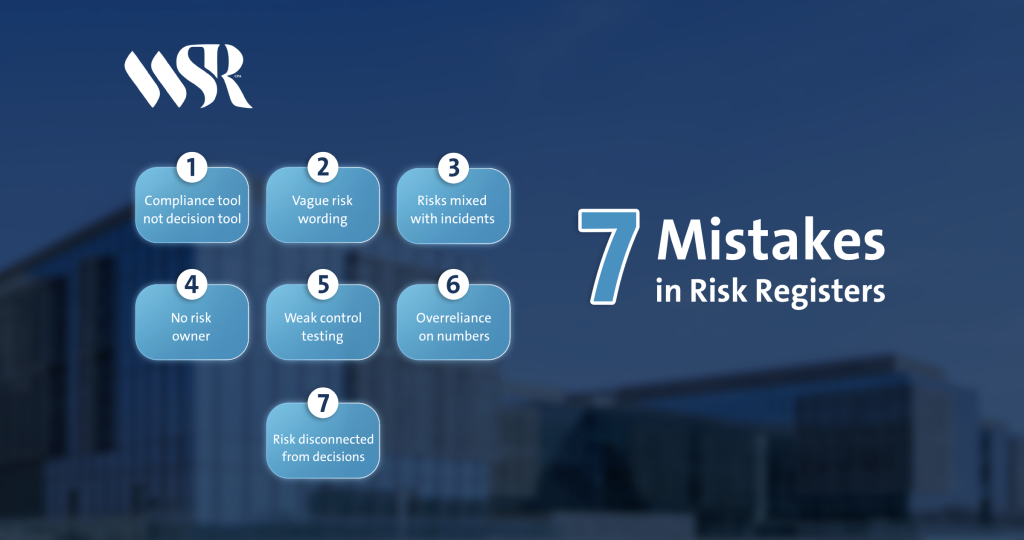
1. Turning the Risk Register into a Compliance Document Rather Than a Decision-Making Tool
One of the most common mistakes in risk governance practices is treating the risk register as a compliance requirement linked to internal or external auditing, rather than as an operational tool continuously used to support decision-making.
Under this model, the register is prepared periodically—often once or twice a year—and then archived within organizational systems without any meaningful updates reflecting daily changes in the business environment, market conditions, or technology landscape.
Over time, what can be described as “operational disconnection” occurs, whereby the risk register becomes completely detached from the organization’s actual reality. In one financial institution that underwent a rapid shift toward digital operations and remote work, management continued relying on outdated risk assessments that no longer reflected the nature of the new infrastructure. This later led to a series of operational disruptions that could have been anticipated had the register remained connected to operational realities.
2. Generic Risk Statements and Poor Actionability
A recurring mistake in operational risk registers is the use of broad and generic statements that provide little analytical value, such as: “operational risks,” “supplier risks,” or “system failures.”
While such descriptions may appear organized from a documentation perspective, they do little to help understand or manage the risk. Risks are not generic labels; they are potential events with specific causes, consequences, and operational contexts.
Professional risk assessment practices require transforming a risk into a precise description that explains what could happen, why it could happen, what consequences may result, and which part of the organization would be affected.
When a risk is transformed from a generic heading into a clear operational scenario, it becomes possible to link it directly to response plans and internal controls, which distinguishes a superficial risk register from an effective one.
3. Confusing Future Risks with Existing Problems
Within many organizations, events that have already occurred are recorded as future risks, which represents a fundamental conceptual error in risk management and compliance.
An issue that has already occurred should be treated as an operational incident requiring root-cause analysis and immediate remediation. A risk, by contrast, is the possibility of a future event that requires anticipation and preparedness.
This confusion shifts the role of the risk register from a proactive tool into a historical record documenting what happened rather than what may happen.
In one banking institution, recurring technical failures were entered into the risk register only after they occurred, without any strategic analysis of the possibility of a broader infrastructure breakdown. Over time, this deficiency led to a major operational crisis affecting thousands of daily transactions, despite the existence of early warning signs that were not properly interpreted.
4. Lack of Clear Risk Ownership
One of the primary indicators of weak risk governance is the absence of clearly assigned ownership for each risk within the register.
In such situations, responsibilities are distributed across multiple departments without identifying a single accountable party responsible for monitoring and implementation, resulting in fragmented accountability.
This situation makes risk management ineffective because each party assumes another party is responsible.
In one technology company, a risk related to customer data breaches remained unresolved for an extended period because responsibilities were divided among cybersecurity, information technology, and legal departments. By the time the incident occurred, it became evident that the lack of ownership was one of the main reasons for the failed response.
5. Overreliance on Quantitative Models and Metrics in Risk Assessment
Although quantitative models are important tools for risk analysis, excessive reliance on them can create what may be described as the “illusion of control.”
Risks do not always emerge in the form of measurable numbers or indicators. They often develop gradually through operational, behavioral, and cultural factors that are difficult to capture through mathematical models.
Numerous major crises have demonstrated that organizations relying excessively on Heat Maps and quantitative indicators often fail to recognize hidden and accumulating risks.
Even organizations equipped with advanced analytical systems may make flawed decisions if human and operational factors are ignored, regardless of the sophistication of their models.
6. Risk Register: Inflation and Loss of Prioritization
When a risk register becomes an extensive list containing every conceivable possibility without distinguishing between significance and impact, it loses its ability to support decision-making.
Under such circumstances, all risks appear equally important, creating confusion in prioritization and making it difficult to allocate resources toward the risks that have the greatest impact on organizational objectives.
Corporate governance best practices indicate that the effectiveness of a risk register is not determined by its size, but by its ability to focus on material risks directly linked to strategic objectives.
7. Separation Between Risk Management and Executive Decision-Making
In many organizations, risks are managed within oversight committees that are disconnected from strategic decision-making processes, creating a gap between analysis and execution.
This separation reduces Enterprise Risk Management to a monitoring function rather than making it an integral part of decision-making.
In reality, every strategic decision—whether expansion, investment, or entry into a new market—is fundamentally a risk decision before it is a growth decision. Isolating such decisions from risk analysis results in incomplete decision-making and limited strategic visibility.
8. Weak Risk Culture Within the Organization
Even the strongest internal control systems cannot succeed if the organizational culture does not support early risk reporting.
In some environments, employees avoid reporting issues due to fear of blame or punishment, causing early warning signs of crises to disappear.
For this reason, building a strong risk culture within the organization is a fundamental component that is just as important as systems and policies.
Second: The Conceptual Mistakes Behind These Problems
The roots of these operational issues lie in several inaccurate assumptions regarding the nature of risk.
The first assumption is the belief that the purpose of a risk register is to predict the future with precision. In reality, the modern business environment does not allow for such certainty, making responsiveness—not prediction—the true objective.
The second mistake is excessive dependence on quantitative models, which often leads organizations to overlook risks that cannot be easily measured, such as organizational culture, human behavior, and sudden decision-making shifts.
The third mistake involves ignoring low-probability, high-impact risks. Organizations often focus on recurring events while neglecting rare events that may have the most devastating consequences.
The fourth mistake lies in misunderstanding the difference between resilient and fragile organizations. Institutions that pursue maximum efficiency and eliminate all redundancy may appear stable, but they are often less capable of absorbing shocks when crises occur.
Third: How These Mistakes Appear in Practice (Real-World Cases)
In one operational organization, the impact of a supplier-related risk was underestimated due to long-term confidence in a stable business relationship. However, a sudden disruption in supply chains resulted in a prolonged operational shutdown, causing significant operational losses and contractual delays that had not been adequately reflected in the risk register.
In another financial institution, the risk register portrayed a completely stable risk profile. However, field reviews revealed that many documented controls were not actually implemented, creating a dangerous gap between documentation and operational reality.
In a third case, reliance on a single key employee without identifying that dependency as a strategic risk led to major disruptions when the employee unexpectedly left the organization, exposing a significant weakness in knowledge management practices.
Similarly, some organizations that focused solely on formal compliance found themselves unable to manage real crises despite being fully compliant with documented procedures on paper.
Conclusion
The risk register itself is not the problem. Rather, its value is determined by how it is designed and used within the organization.
When the register becomes disconnected from operational realities and turns into a purely administrative exercise, it loses its fundamental role in supporting decision-making and protecting the organization from genuine threats.
Effective risk management does not depend on the volume of documentation. It depends on the quality of understanding, integration of risks into decision-making, and building organizational capability to respond before a crisis occurs, not afterward.