With escalating risks, increasing regulatory requirements, and rising investor expectations, selecting the appropriate reference framework for Corporate Governance, Enterprise Risk Management, and Internal Control has become a strategic decision of the highest importance. However, organizations often fall into the trap of searching for a “comprehensive ideal framework” that eliminates the need for others, while professional practice demonstrates that each framework was designed to address a specific dimension of the Governance, Risk Management, and Compliance ecosystem.
Although these frameworks are frequently mentioned within the same context, each emerged to address a different challenge and operates at a distinct level within the institutional system. Understanding this distinction is not merely theoretical; it is essential for selecting the appropriate framework and avoiding the misapplication of an unsuitable model to a different regulatory or operational environment.
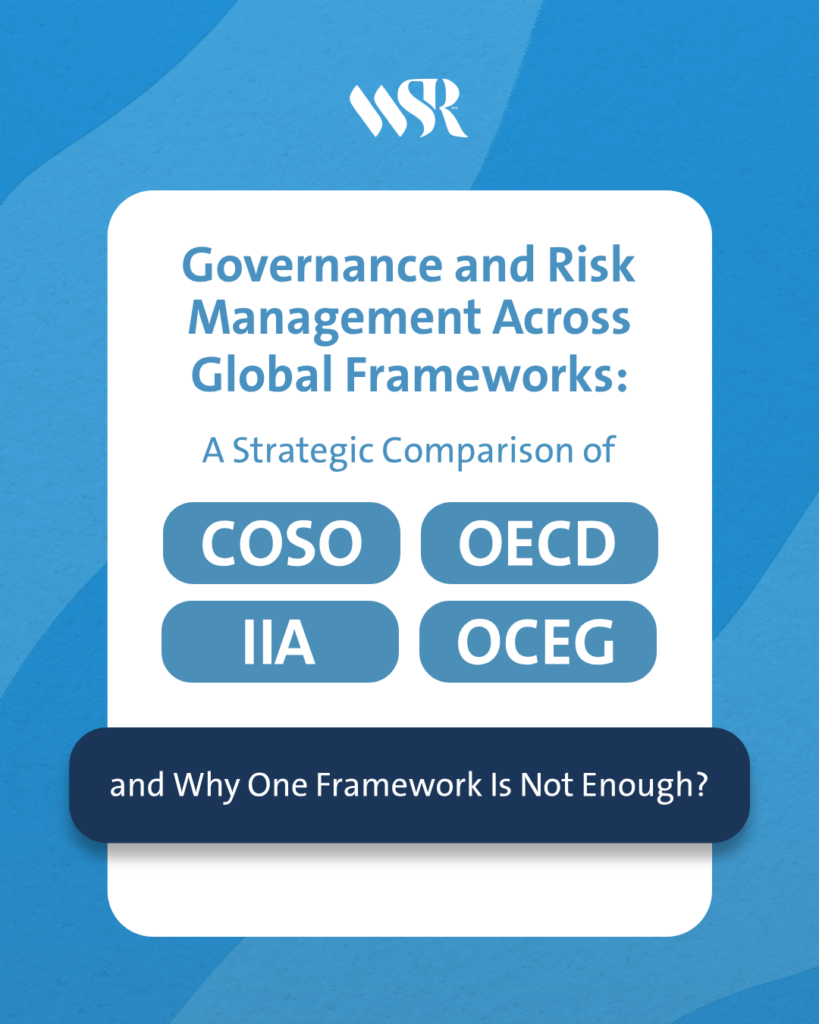
This article provides an analytical comparison of four of the most prominent global frameworks: COSO, OECD, IIA, and OCEG, clarifying the scope of each, its optimal use cases, and the reasons why a single framework cannot serve as a universal solution.
First: COSO Framework – The Reference for Internal Control and Enterprise Risk Management
The COSO Framework was originally established to enhance the reliability of financial reporting following a series of corporate collapses. It later evolved into a comprehensive Enterprise Risk Management (ERM) framework. Its underlying philosophy is that Risk Management should not be managed in isolation from Corporate Governance, but rather integrated into objective-setting and decision-making processes.
The updated COSO ERM Framework reframed Risk Management by linking it directly to organizational performance and value creation. The focus is no longer solely on preventing losses, but on improving decision quality by understanding risk appetite and evaluating strategic alternatives in light of uncertainty.
COSO is typically used by organizations requiring a structured system to identify risks, assess them, align them with objectives, and document related Internal Control mechanisms. It is widely adopted in environments subject to market oversight or stringent disclosure requirements because it provides a clear structure that can be reviewed and evaluated.
However, COSO does not offer a detailed model for building an overarching Corporate Governance culture or regulating the relationship between boards of directors and shareholders. It assumes the existence of an established Governance framework within which risk oversight can be exercised.
Accordingly, COSO is strong in answering “how to identify, assess, and control risks,” but it does not replace strategic Governance frameworks or comprehensive Compliance models
The Five Components of the COSO Framework
- Control Environment
The control environment forms the foundation of the internal control system. It includes principles related to integrity and ethical values, oversight by the board of directors, establishment of a clear organizational structure defining authority and responsibility, commitment to competence, and reinforcement of accountability within the organization. - Risk Assessment
This component focuses on identifying and analyzing risks that may hinder the achievement of objectives. It includes specifying suitable objectives, identifying and analyzing potential risks, assessing fraud risks, and understanding significant changes that may impact operations. - Control Activities
Control activities involve implementing policies and procedures to ensure internal controls function effectively. This includes selecting and developing appropriate control activities, leveraging relevant technologies, developing and selecting necessary information, and ensuring accurate execution of policies and procedures. - Information and Communication
Information and communication support the effective implementation of internal control. This component emphasizes the use of relevant, high-quality information for decision-making, effective communication with internal and external stakeholders, and ensuring clarity of roles and responsibilities. - Monitoring Activities
This includes ongoing or separate evaluations of internal control components to ensure effectiveness and identify deficiencies. Findings are analyzed and reported to senior management, enabling continuous improvement of the control system.
Second: OECD Principles – A Macro-Level Corporate Governance Reference
In contrast to COSO, the OECD Principles of Corporate Governance do not provide an operational model for managing risks. Instead, they establish a normative framework defining how authority should be structured within an organization and how the rights of shareholders and stakeholders should be protected.
These principles are often used as regulatory references at the national and capital market levels. Legislators rely on them when drafting corporate laws or updating listing requirements. Their focus centers on transparency, fairness, accountability, and the strategic oversight role of the board.
The fundamental distinction is that the OECD framework does not instruct organizations on how to build a risk matrix or design an internal control system. Rather, it defines the governing environment within which such systems should operate. In other words, it establishes the “rules of the game,” not the operational details.
Therefore, it is suitable for designing or reforming governance structures at institutional or national levels, but it is insufficient on its own for managing daily operational or financial risks.
Third: IIA Framework – The Professional Reference for Internal Auditing and Governance Assurance
The IIA framework focuses on a specific element within the governance ecosystem: internal auditing. The professional standards it issues are not intended to establish a comprehensive governance system, but rather to ensure the existence of an independent function that evaluates the effectiveness of governance, risk management, and internal control systems.
Its primary strength lies in reinforcing the concept of independent assurance. Even if an organization adopts COSO or any other model, effective implementation depends on the presence of an internal audit function capable of objectively evaluating compliance and identifying deviations.
The IIA framework becomes essential when an organization seeks to strengthen internal accountability or when the audit committee requires an objective assessment of existing systems. It is not a substitute for governance or risk management frameworks, but rather a mechanism for evaluation and continuous improvement.
Fourth: OCEG Framework – An Integrated Governance, Risk, and Compliance (GRC) Model
The OCEG GRC framework emerged in response to the pressing need of large and complex organizations to integrate governance, risk management, and compliance functions into a cohesive system. While many organizations address these aspects separately, this separation often leads to policy duplication, conflicting responsibilities, and fragmented reporting, ultimately weakening the effectiveness of oversight and decision-making.
OCEG is built on a philosophy of integration rather than separation. It aligns risk identification processes with policy and regulatory compliance while ensuring that the board of directors maintains continuous visibility into control and compliance levels across the organization. Governance is viewed not merely as a regulatory structure, but as an ongoing process embedded in operational activities and linked to strategic objectives and performance measurement.
This integration enables organizations to tailor tools and processes according to their operational nature, regardless of size or complexity, while maintaining a comprehensive governance perspective. OCEG also supports innovation through flexible implementation, allowing organizations to begin with basic risk and compliance frameworks and gradually expand them to encompass all governance and internal control dimensions.
In practice, the framework provides mechanisms to link policies to daily activities, ensure operational procedures align with strategic objectives, and foster a culture of accountability and transparency. Implementing OCEG GRC is therefore not limited to adopting a tool or document; it involves developing an integrated methodology for managing risks and compliance within a unified governance process, enabling more informed decisions and faster responses to regulatory and operational changes.
In summary, OCEG represents an optimal solution for organizations facing multiple regulatory frameworks and seeking a unified methodology that integrates governance, risk, and compliance, while maintaining adaptability to internal and external environmental changes and transforming risk and compliance management into a strategic performance driver.
Key Differences Among the Frameworks
The distinctions among these frameworks can be understood by examining the level at which each operates within the organization:
- OECD operates at the level of high-level governance and stakeholder relationships.
- COSO operates at the level of risk management and internal control aligned with objectives.
- IIA operates at the level of independent evaluation and assurance.
- OCEG operates at the level of cross-functional integration.
This difference in scope explains why a single framework cannot address all needs. A framework that defines principles of fairness and transparency does not replace a structured risk management system. A risk management system does not eliminate the need for independent assurance. And all of these may lose effectiveness if not integrated within a cohesive structure.
Why One Framework Is Not Suitable for All
The limitation does not lie in the frameworks themselves, but in differences in institutional contexts. Organizational size, industry nature, regulatory intensity, ownership structure, and managerial maturity all influence the most appropriate framework.
Small organizations may require clear Governance principles without structural complexity. Listed companies need documented Risk Management systems. Multinational corporations require integration between Compliance and Risk Management functions. Public sector entities may emphasize transparency and societal accountability.
Thus, searching for the “single best framework” is an imprecise approach. A more mature methodology involves selecting frameworks based on purpose, integrating them where necessary, and maintaining philosophical coherence across components.
Conclusion
COSO, OECD, IIA, and OCEG are not competing substitutes, but complementary tools within the Corporate Governance ecosystem. Each addresses a specific dimension of the relationship between authority, Risk Management, Internal Control, and Compliance.
Intelligent selection is not about adopting one framework and rejecting others, but about understanding the role each plays and designing a system aligned with the organization’s reality and strategic objectives.
Ultimately, effective Governance is not measured by the number of adopted frameworks, but by its ability to transform risks into informed decisions and decisions into sustainable value. Mature organizations do not search for a universal framework; they build integrated systems that leverage the strengths of each framework within its domain, achieving sustainable performance and long-term trust.